
Flatwork for a city at sea level
Concrete Contractors in Norfolk, VA
Driveways, patios, walks and slabs built on a drained base and pitched to shed Norfolk's rain, with the price in writing.
- Free on-site measuring visit
- Written, itemized quote with drainage and base spelled out
- Every slab sloped to shed water away from the house
Concrete Built Around Norfolk's Water
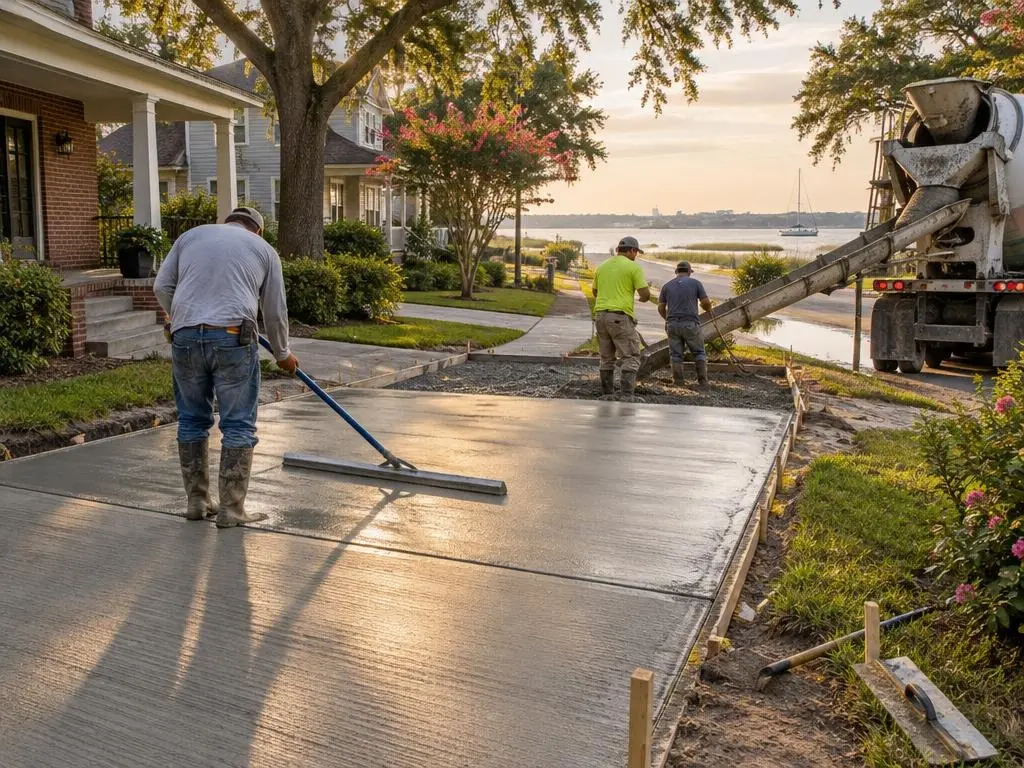
Concrete Contractors Norfolk builds and repairs driveways, patios, stamped concrete, sidewalks, steps and slabs for homes in Norfolk, Virginia. Few cities give concrete a tougher job when it comes to water. Norfolk sits where the Elizabeth River meets the Chesapeake Bay, Wikipedia puts its elevation at 6.9 feet, and the climate table for Norfolk International Airport shows 49.18 inches of precipitation in a normal year. Good concrete contractors in Norfolk plan the drainage before they plan the pour.
Low ground, high water
Wikipedia describes Norfolk as low-lying and largely surrounded by water, with land that is slowly subsiding and some areas that flood regularly at high tide. The Pew Charitable Trusts, writing about the city's 2018 zoning rewrite, reports that local sea level has risen more than a foot in the last 80 years, and that sinking ground accounts for about half of that change.
For a slab, that means water arrives from two directions: rain from above and wet soil from below. What we do about it on every job:
- Slope with intent. Driveways fall toward the street, patios and walks fall away from the foundation, and we check the finished grade so nothing sends water toward a crawlspace or door.
- A base that drains. Soft, organic soil comes out and compacted crushed stone goes in, so the slab rests on something firm that does not hold water.
- Thickness for the load. About 4 inches for patios and walks, more where vehicles park or turn.
- Reinforcement where it helps. Rebar or wire mesh holds cracked pieces together when the ground underneath shifts.
- Joints on a plan. Concrete shrinks as it cures, so we place control joints where a crack can form in a straight, intended line.
Hot summers, mild winters
The same climate table gives July an average high of 89.4 degrees and a low of 72.8, while January averages 50.7 and 33.6. Snow averages just 6.2 inches a year. That puts summer heat, not snow, at the top of the list for concrete in Norfolk. On a hot, humid day concrete stiffens fast, and a surface that dries before the slab below it sets can end up weak and dusty. Summer pours here start early, and the slab is kept moist or sealed with curing compound as soon as it is finished. Winter still brings nights near freezing, so outdoor slabs get an air-entrained mix and should be spared from rock salt in their first winter. Wikipedia also notes that tropical storms usually brush Norfolk, with the highest risk from mid-August to the end of September, so a flatwork job in that window gets a weather check before pour day.
Older houses, older concrete
Norfolk's housing skews old. Point2Homes, summarizing the Census Bureau's 2019 to 2023 survey, gives a median year built of 1964. About 15 percent of the city's homes were built in 1939 or earlier, and adding the 1940s and 1950s brings it to roughly 45 percent built before 1960. On long-established blocks, the walks, stoops and narrow side drives may have been in place for generations, and tree roots and washed-out soil have had a long time to lift or sink them.
The same data shows something else: only about 46 percent of homes are owner-occupied, and just under half are single-family detached houses. A lot of concrete work in Norfolk is ordered by landlords getting a rental ready, or by owners fixing a trip hazard before someone gets hurt.
The city side of the job
The strip between your property line and the street belongs to the city. Norfolk's Public Works Right of Way division issues permits for construction in the right-of-way, inspects sidewalk, curb and gutter restoration, and lists driveways among the things it enforces. Its FAQ asks applicants to submit plans 7 to 14 days ahead of work, and the permits office is at 757-664-7306. The city's list of right-of-way permit types includes a Driveway Entrance Permit for a residential apron up to 20 feet wide, and it notes that adding or extending a driveway needs a zoning certificate from Planning before that permit. If a job blocks the sidewalk, a closure permit is needed too. We work out which of these your job needs and fold the lead time into the schedule.
What we pour
- Driveways: replacement drives, new aprons at the curb, widening and parking pads.
- Patios: broom-finished, colored or exposed-aggregate patios and the walks that connect them.
- Stamped concrete: slate, stone and brick patterns for patios, entries, borders and pool surrounds.
- Sidewalks and steps: front walks, side paths, stoops and poured steps.
- Slabs: garage floors, shed and HVAC pads, and slabs for outdoor kitchens and carports.
- Repair and leveling: lifting sunken panels, resurfacing, crack sealing and replacing broken sections.
What a visit looks like
We come out, measure, and watch where the water wants to go. We note the things that change the price: how much old concrete comes out, roots near the slab, how close a ready-mix truck can park on a narrow street, and whether the work crosses into the right-of-way. You get a written quote with each part priced on its own line. Call (757) 520-4973 to set a time.
Why Homeowners Call Concrete Contractors Norfolk
Drainage planned first
Every slab is pitched to shed water away from the house, on a compacted stone base that drains.
Line-item quotes
Tear-out, base, thickness, steel, finish and sealing each priced on their own line.
Right-of-way handled
We sort out whether your job needs a Driveway Entrance Permit, a zoning certificate or a closure permit.
Repair when it is enough
Leveling or resurfacing is quoted next to replacement when the slab can be saved.
Common Questions
What should I look for in residential concrete contractors in Norfolk?
Ask each bidder how the slab will drain, how deep the stone base will be, how thick the concrete will be and whether it is reinforced. In a city as flat and wet as Norfolk, a contractor who cannot explain where the water goes is guessing. Get the answers in writing, along with who handles any right-of-way permit.
Do I need a permit to replace my driveway apron in Norfolk?
Work in the city right-of-way, which usually includes the apron and the sidewalk crossing, goes through Norfolk's Public Works Right of Way division. Its permit list includes a Driveway Entrance Permit for residential aprons up to 20 feet, and adding or extending a driveway needs a zoning certificate from Planning first. The permits office is at 757-664-7306, and we confirm what your address needs before scheduling.
Why does the concrete around my house keep sinking?
Usually because water is getting under it. Downspouts that dump next to a slab, a walk that slopes toward the house, or a thin base over soft soil can all wash out support until the concrete drops. Lifting the slab fixes the symptom; fixing the drainage keeps it from happening again.
What does a concrete driveway cost in Norfolk?
HomeGuide's national cost guide lists a standard concrete driveway at $6 to $10 per square foot, or $2,400 to $6,000 for a 20 by 20 foot two-car drive at standard to basic quality. Removing an old driveway adds $2 to $6 per square foot. Your written estimate after we measure is the actual price.
Is summer a bad time to pour concrete in Norfolk?
No, but it needs a plan. July highs average close to 90 degrees, so we start early in the day and keep the surface from drying out while the slab cures. Hurricane season matters too, so late-summer pours get a close look at the forecast.
Can you fix a sidewalk that tree roots have lifted?
Often, yes. A lifted panel on your own walk can be removed and repoured, sometimes after the root is cut back with an arborist's advice. If the panel is the public sidewalk in the right-of-way, the city's Right of Way division is the first call, and we can tell you which side of the line it is on.
Do you work on rental properties?
Yes. Point2Homes, summarizing Census data, puts Norfolk's owner-occupied share at about 46 percent, so many homes here are rentals. We can meet a property manager on site and send the quote to whoever approves it.
How long before I can drive on new concrete?
HomeGuide's driveway guide says to wait at least 7 days for cars and about 30 days for heavy vehicles, with full cure at 28 to 30 days. Walking on it is usually fine after a day or two. We give you dates based on your slab and the weather that week.
Our Concrete Services
Six kinds of residential concrete work, each planned around Norfolk's rain, heat and low ground.
Concrete Driveways
Replacement driveways, new curb aprons and widening, on a drained stone base and pitched toward the street.
Learn more →Concrete Patios
Backyard patios in broom, colored or exposed-aggregate finishes, pitched away from the house and sized for how you use the yard.
Learn more →Stamped Concrete
Patterned and colored concrete for patios, entries, borders and pool surrounds, sealed against sun and mildew.
Learn more →Sidewalks & Steps
Front walks, side paths, stoops and poured steps, replaced where roots and settling have made them a trip hazard.
Learn more →Concrete Slabs
Garage floors, shed and HVAC pads, carport slabs and outdoor kitchen bases, set high enough and thick enough for the job.
Learn more →Concrete Repair & Leveling
Lifting sunken slabs, resurfacing worn concrete, sealing cracks and replacing broken sections when repair is not enough.
Learn more →
Where We Work
Most of our jobs are inside Norfolk, from Ocean View and Willoughby Spit on the bay down through Ghent, Larchmont, Colonial Place and the blocks near Old Dominion University, and across to Berkley. We also work in the cities that surround it: Virginia Beach to the east, Chesapeake to the south, Portsmouth across the Elizabeth River, and Suffolk to the west, plus Hampton and Newport News on the Peninsula side of the harbor. Each of these is an independent city with its own permit office, so the rules for an apron or a new driveway change when you cross a city line. The town pages cover what we found about each one, from housing age to local permit steps.
- Concrete Contractors in Norfolk, VA
- Concrete Contractors in Virginia Beach, VA
- Concrete Contractors in Chesapeake, VA
- Concrete Contractors in Portsmouth, VA
- Concrete Contractors in Suffolk, VA
- Concrete Contractors in Hampton, VA
- Concrete Contractors in Newport News, VA
- Concrete Contractors in Poquoson, VA
- Concrete Contractors in Smithfield, VA
- Concrete Contractors in Carrollton, VA
- Concrete Contractors in Ghent, VA
- Concrete Contractors in Ocean View, VA
- Concrete Contractors in Colonial Place, VA
- Concrete Contractors in Larchmont-Edgewater, VA
- Concrete Contractors in South Norfolk, VA
- Concrete Contractors in Great Bridge, VA
- Concrete Contractors in Western Branch, VA
- Concrete Contractors in Deep Creek, VA
- Concrete Contractors in Hickory, VA
- Concrete Contractors in Kempsville, VA
- Concrete Contractors in Sandbridge, VA
- Concrete Contractors in Pungo, VA
- Concrete Contractors in Phoebus, VA
Get a Concrete Contractors Estimate in Norfolk
We measure, check the drainage and price the job in writing, in Norfolk and the nearby Hampton Roads cities.